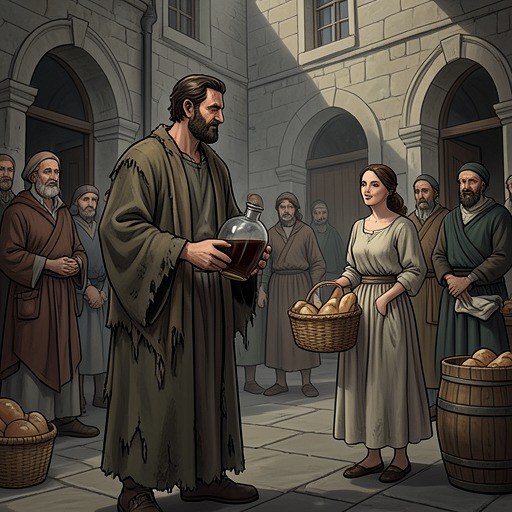
Federigo’s falcon
The DecameronFederigo’s falcon is both the last possession that sustains Federigo degli Alberighi and the bird he unknowingly sacrifices to honor Madam Giovanna. The irreversible meal brings together the story’s central contrasts: a living creature prized for its excellence, a host reduced to poverty, and a gift whose meaning becomes clear only after it can no longer be given.
The Falcon in Federigo’s Decline
The falcon remains with Federigo after his efforts to win Madam Giovanna’s love have exhausted his wealth. He had once spent freely on jousts, entertainments, and gifts, but she had not returned his affection. When his substance was gone, he withdrew to his small farm at Campi, where he lived meagerly, bore his poverty patiently, and asked nothing of anyone. The bird was the sole notable possession left to him, and he hawked when he could: it was not merely a token of former prosperity but part of how he lived and a source of pleasure in his reduced circumstances.
The narrative stresses the bird’s exceptional value. Madam Giovanna’s son had repeatedly seen Federigo fly it and became deeply attached to it, though he hesitated to ask for it because he knew how dear it was to Federigo. The falcon’s reputation reaches Giovanna through what she hears of it: it is said to be the best that ever flew. Its worth therefore has more than one measure. To the boy it is an object of fascination and a hoped-for comfort; to Federigo it is his remaining diversion and livelihood; to Giovanna it is the possible means of answering her child’s urgent wish.
A Visit with an Unspoken Purpose
After her husband’s death, Giovanna spends the summer at her nearby estate with her son. When the boy falls ill, she repeatedly asks what he desires, promising to obtain it if she can. He names Federigo’s falcon, believing that having the bird might help him recover. Giovanna knows Federigo’s history of loving her and understands that asking for the falcon would take from him the one pleasure poverty has left. She is troubled by this conflict between her child’s need and the cost of the request, but finally decides to go herself rather than send someone else.
The next morning, Giovanna arrives at Federigo’s little house with a companion. Federigo is in his garden overseeing small tasks; hearing that she has come, he hurries to greet her, rejoicing and astonished. She explains that she has come to make amends for the suffering he endured through loving her and asks to dine with him. Her actual request remains unstated while he receives her courteously and arranges for a husbandman’s wife to keep her companion in company. Only after the meal does Giovanna explain that her son is ill and ask for the falcon, which she knows is precious to Federigo and hopes may save her child.
The Bird Served at Table
The visit confronts Federigo with the poverty he had not fully felt until that morning. Though he has entertained many people in the past, he now has nothing with which to honor this guest. He will not ask his laborer for help or turn to anyone else, and finds neither money nor anything to pawn. Seeing the falcon on its perch in his little sitting room, he decides that it is a dish worthy of Giovanna. He has the bird killed, plucked, prepared, and roasted; then, with the table laid in the white cloths he still owns, he returns to the garden with a cheerful face and invites his guests to dine.
Giovanna and her companion eat the falcon without knowing what they have been served. The choice is an act of hospitality, but it also makes the later request impossible to fulfill: Federigo has already given the bird away in the only form he can offer. When Giovanna asks for it, he weeps before answering. She first supposes that his tears come from grief at parting with his falcon. Instead, he explains that he had it roasted to honor her and then shows her its feathers, feet, and beak as proof. The remains turn the meal into evidence of both his generosity and the terrible timing of her request.
Loss, Recognition, and the Ending
Giovanna first reproaches Federigo for killing so fine a falcon to feed a woman, then inwardly admires the greatness of soul that his poverty has not diminished. She must return to her son without the bird. Before many days pass, the boy dies. The account leaves the cause unresolved: his death may follow his disappointment at not receiving the falcon, or his illness may simply have been fated to bring him to that end. The bird’s absence thus remains bound to Giovanna’s grief, but the narrative does not claim that giving it to the boy would have saved him.
Widowed, still young, and very wealthy, Giovanna is urged by her brothers to marry again. She recalls Federigo’s final act of magnificence and chooses him, despite his lack of property. Her brothers question the choice on precisely that material ground; she answers that she would rather have a man who lacks riches than riches that lack a man. They give her to Federigo with all her wealth. He becomes more careful with his substance, and the two live together in joy and comfort.
The falcon’s role in this resolution depends on its destruction, not its transfer to the sick boy. Federigo cannot grant Giovanna the gift she asks for because he has already spent the bird in her honor; that failure makes visible a generosity she had not previously witnessed. The falcon is valued throughout in relation to human purposes—sport, subsistence, a child’s wish, and hospitality—and the story gives no separate account of the bird’s experience. Yet its concrete remains interrupt those human intentions: what Federigo meant as a worthy dinner becomes the proof that the cherished object cannot be recovered, and the memory through which Giovanna comes to recognize his worth.